
2026-09-05 ·
Signs of Subterranean Termites in Florida Sandy Soil
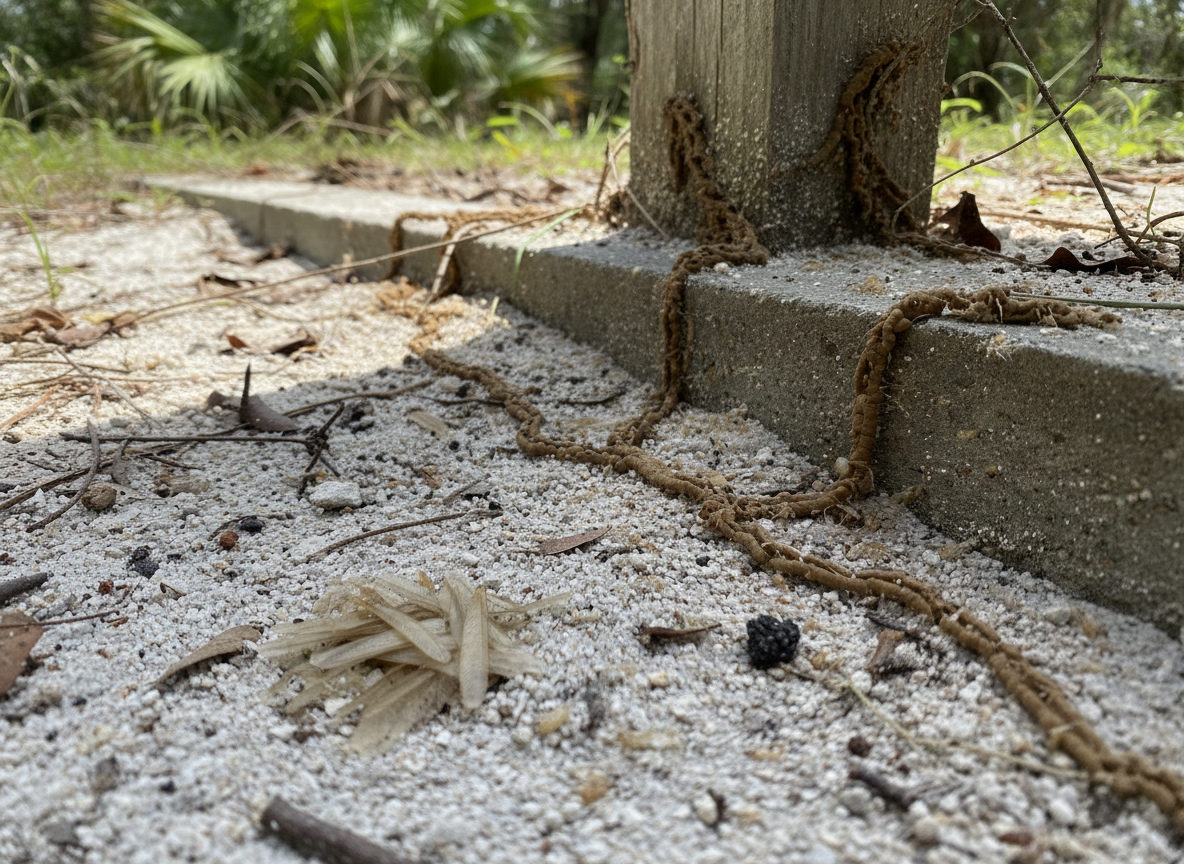
Subterranean termites in Inverness sandy soil reveal their presence through earthen mud shelter tubes along stem walls, discarded translucent wings on interior windowsills, and baseboards that sound hollow when tapped. In Citrus County's humid subtropical climate, porous Candler and Apopka fine sands offer almost zero mechanical resistance, allowing subterranean colonies (Reticulitermes flavipes) to forage year-round beneath concrete slabs.
Mud Tubes Along Slab Foundations and Stem Walls
Citrus County's well-draining sandy loam forces subterranean workers to build pencil-thick shelter tubes out of soil, saliva, and digested cellulose to shield themselves from dry air and predatory ants. These conduits appear along foundation stem walls, inside garage expansion joints, and around plumbing rough-ins in Citrus Hills (34453) and Inverness Highlands North (34453). On older pier-and-beam bungalows in Downtown Inverness (34450), tubes travel vertically up brick piers to reach untreated floor joists. To check if a mud tube is active, scrape away a 1/2-inch segment; if worker termites rebuild the passage within 24 to 48 hours, an active colony is actively foraging inside the structure.
> Suspect Active Termites in Your Foundation? > Subterranean colonies tunnel beneath Florida slabs 24/7 without surface warning. Call (352) 830-4114 to dispatch a licensed Citrus County inspector for same-day perimeter evaluation and official FDACS clearance.
Early Spring Swarmers and Discarded Wing Piles
Between February and April, mature subterranean termite colonies release thousands of winged alates (reproductives) the morning after a warm spring downpour. These dark-bodied swarmers measure approximately 3/8-inch long with two pairs of identical, milky-translucent wings that shed within minutes of landing. Piles of shed wings on windowsills, in sliding glass door tracks, or around bathroom sinks indicate swarmers emerged from within the structure—confirming a mature colony of 60,000 to over 250,000 workers already established beneath your slab.
Diagnostic Table: Subterranean vs. Drywood vs. Flying Ants
| Indicator | Eastern Subterranean Termites | Drywood Termites | Swarming Carpenter Ants | | :--- | :--- | :--- | :--- | | Primary Habitat | Soil, sub-slab, foundation mud tubes | Dry structural wood, attic trusses | Moist wood voids, tree hollows | | Body Shape | Straight waist, straight bead-like antennae | Straight waist, short antennae | Pinched waist, elbowed antennae | | Wing Anatomy | 4 equal-length milky-translucent wings | 4 equal-length iridescent wings | Unequal wings (front larger than rear) | | Residue / Frass | Damp sandy soil packed in wood galleries | Hard, six-sided hexagonal pellets | Coarse wood shavings mixed with insect parts | | Swarm Timing | Daytime, February–April after rain | Evening/dusk, May–July | Daytime, spring through late summer |
Wood Damage Patterns in Slab-on-Grade Homes
Because subterranean termites require moisture from sandy soil, they do not nest inside dry structural lumber. Instead, they tunnel upward through foundation expansion cracks and plumbing cutouts (bath traps), eating the soft springwood along the grain while leaving the harder summerwood intact. This produces a hollowed, layered honeycombed damage pattern caked with damp soil and mud plastering. In Inverness Highlands South (34452), tapping suspect door jambs, window stools, or baseboards produces a papery, hollow sound, and light pressure with a screwdriver will break through the paint layer to expose soil-filled galleries.
Sandy Soil Dynamics and Lake Basin Water Tables
Citrus County's shallow water tables near Lake Henderson, Lake Tsala Apopka, and Gospel Island (34452) maintain optimal ground moisture within sandy soil layers year-round. This allows subterranean colonies to establish vast lateral foraging territories spanning hundreds of feet from the central nest. In golf-adjacent communities like Point O' Woods (34452), frequent turf irrigation further accelerates subterranean activity along foundation perimeters. Because loose sand causes standard surface treatments to leach and degrade rapidly, lasting protection requires deep perimeter soil trenching with non-repellent liquid termiticides (such as Termidor HE) or commercial in-ground bait networks installed flush with the grade.
If you spot mud shelter tubes, spring swarmers, or hollow-sounding baseboards, avoid spraying household insecticides—contact sprays simply force the colony to bypass treated areas and attack adjacent interior wall studs. Schedule a certified structural audit through our Termite Control & WDO Inspections team, or call our local dispatch office at (352) 830-4114. For real estate transactions, review What to Expect During a Florida WDO Inspection in Citrus County, or read our guide on How to Keep Lakefront Roof Rats Out of Your Inverness Attic. Inverness Pest Solutions operates from Main St, Inverness, FL 34450, servicing all residential properties across ZIP codes 34450, 34451, 34452, and 34453 from 7:00 AM to 8:00 PM daily.